Pages

Tuesday, October 8, 2013

Breathing New Life into Civil War Imagery with Color

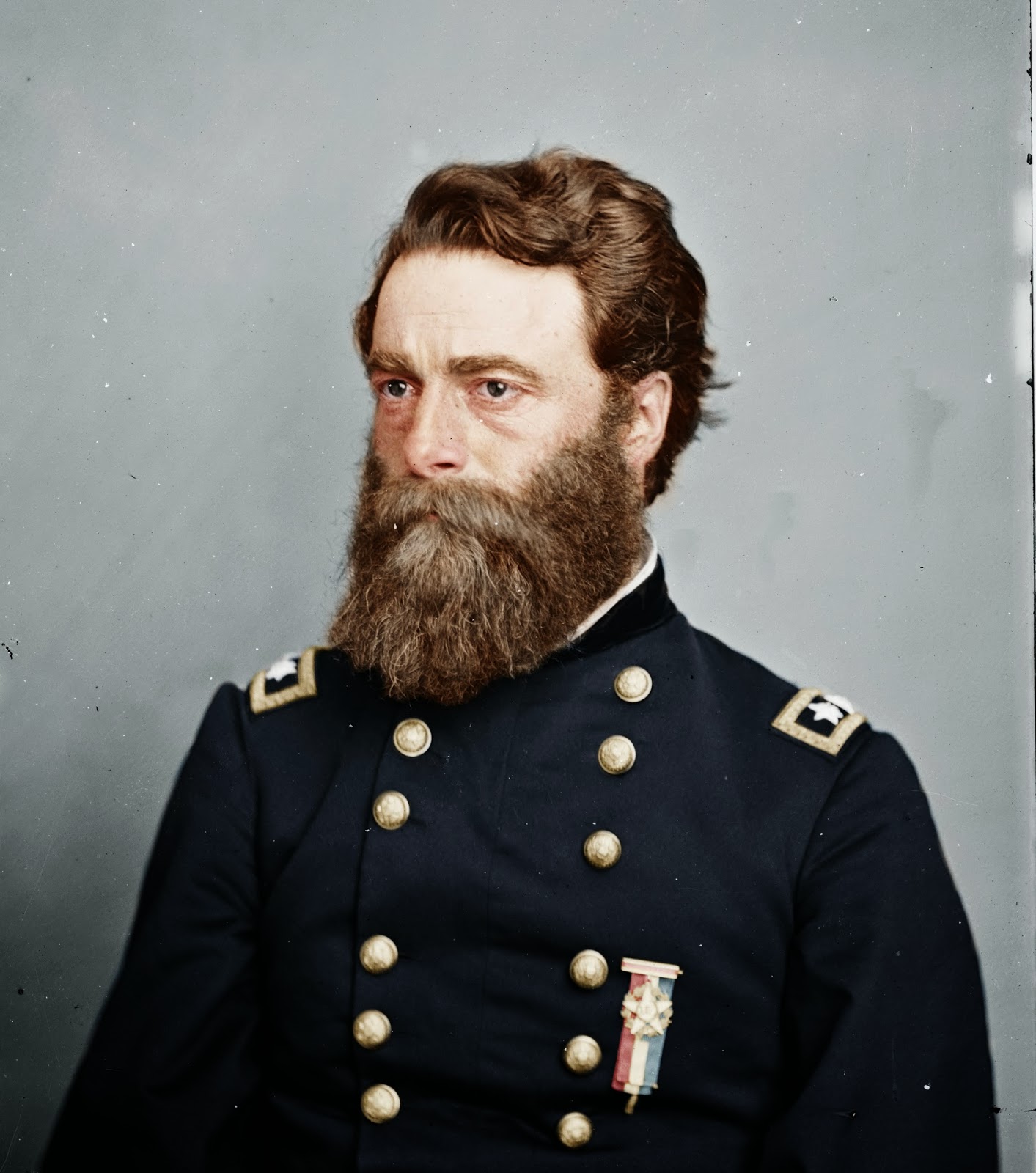
General Joseph E Johnston, CSA

The American Civil War, thanks to Matthew Brady and the advent of the wet plate process of capturing images, was the first war to be documented by the camera lens.  Every student of history should be grateful for Brady's efforts, often at great peril to himself, to capture individuals and moments from that time forever.

The process of capturing an image in the 19th century was painstaking and painful.  Subjects had to remain still while the exposure was captured.  Plates were fragile and susceptible to damage from any number of sources of which light was probably the least concern.  Imagine driving a horse drawn carriage filled full of plates of glass and jars of chemicals through rural 19th century America during a war.  It's a miracle that we have many of these images at all.

Brady was a master photographer.  His composition, lighting, and subject evince profound technical, and artistic talents.  And yet, he was limited by the technical restrictions of the day.

Our efforts to connect with his subjects are often frustrated by one simple and yet glaring omission:  Color.

For some time now on Reddit, a group of artists has sought to revivify old photos by imbuing them with color.  They research every aspect of the subject and strive for utmost historical accuracy.  The results are spectacular.

Click to see full size image
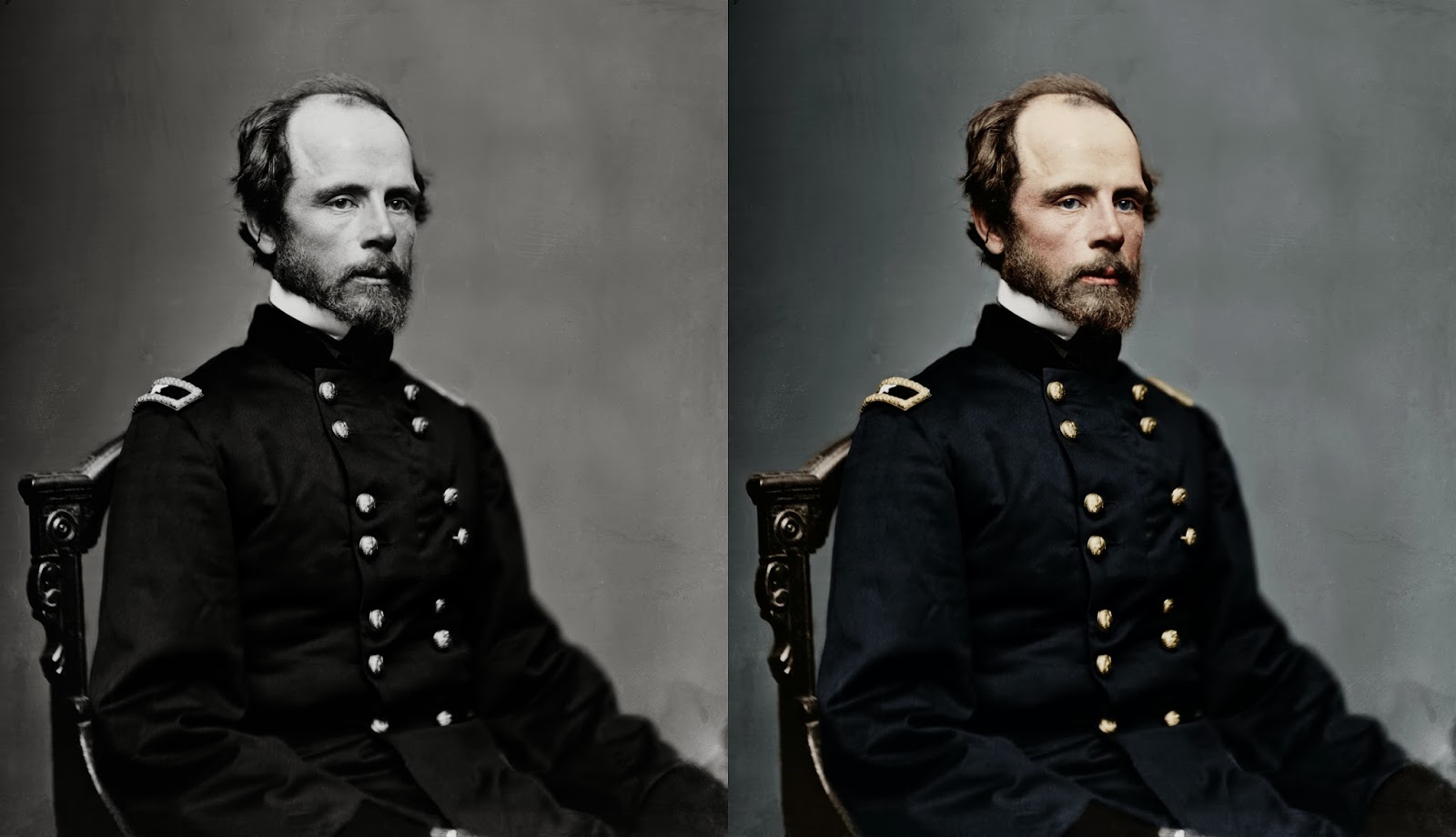
For example, consider the side by side comparison of the black and white image of Major General Darius N. Douch with the color image above.  The addition of color brings the subject into our modern visual parlance.  Suddenly, this is no longer an image in a history book, but a living person.


The above image is perhaps an even more shocking demonstration of the extent to which color brings the subject to life.  The individual above, minus the shackles, could appear in any contemporary media ad campaign—think Calvin Klein, Banana Republic, etc.  But in fact this is Lewis Powell, one of the conspirators in the Lincoln assassination.  Powell's assigned part in the plot was to kill Secretary of State William Seward.  He stabbed Seward numerous times in his home and left him permanently disfigured but was subsequently captured and hanged along with Mary Surratt, David Herold, and George Atzerodt.

Here are a few more of what I consider to be the most compelling works of Mads Madsen ("zuzahin" on Reddit) and Jordan Lloyd.  Click on the images to view the detailed, full size versions.  And see the bottom of the article for where you can follow these artists and enjoy their work.  All colorized images below are copyright of Mads Madsen, Jordan Lloyd, or their respective owners.

James A. Garfield, future President of the United States, as a Brigadier General
Colonel Alex Hayes, KIA 1864 during the Wilderness Campaign
John A. Dahlgren
Major General George Armstrong Custer
Major General Joseph Anthony Mower (of "Mower's Charge" at Bentonville fame)
Major General Ambrose Burnside
View from the Capitol at Nashville, Tennessee, 1864 (color version by Sanna Dullaway)
To see more of these artists' incredible work, visit:

Colorized History Reddit Forum — Includes images from WW1, WW2, miscellaneous historical events, popular culture, etc.

American Civil War Colorized Reddit Forum —Mads Madsen's subreddit dedicated to colorized versions of Civil War imagery


Wednesday, October 2, 2013

Williams "Cleaner" Bullets -- The Confusion Persists

It's amazing how much confusion persists to this day about Williams "Cleaner" Bullets.  Here's a recent example from eBay.


This seller claims to have a "Confederate" Cleaner Bullet from Appomattox.  Of course, there's no such thing.  Williams "patent" bullets, Types 1, 2, and 3, were manufactured by Elijah D. Williams exclusively for Federal troops under contract with the US Arsenal.  The Confederacy never had Williams bullets, although today many areas of the South are still covered with Type 3 bullets that were discarded by Union troops.

Here's my article on the blog about the history of these projectiles which continue to be a source of confusion and misinformation.  Caveat emptor!

Monday, September 30, 2013

More History Succumbs to the March of the Bulldozer


You're looking at a unique piece of history which, after surviving for 148 years after the Civil War, is now gone forever.

The photo above shows the original 19th century road bed approaching the city of Morrisville, North Carolina.  A few weeks ago, it was exposed by construction, the surrounding slopes denuded of trees for the first time in over a century, providing an all-too-brief opportunity to see in broad, 21st century daylight, a road almost untouched since the time of the War.

In fact, this was the very road used by General Judson Kilpatrick's cavalry during their attack on Morrisville Station from April 13 -15, 1865.  They followed the road pictured above, traveling from the top of the hill down the slope to the foreground of the image.  From there, they would have had their first sight of Morrisville Station itself just across Crabtree Creek, its rail yards filled with cars loaded full of troop supplies and Confederate wounded.

Kilpatrick's reaction on seeing the cars was to quickly unlimber his guns and proceed to shell the station, with questionable accuracy as it turned out.  Today, the chimney of the Page House in Morrisville, about 60 meters west of the tracks, still bears the scars from some of those shells.

Map showing path of original road, artillery position, and the Page House.

It didn't take long for Johnston to get his troops and supplies moving once the shells started falling and the trains pulled out of Morrisville and steamed away for Greensboro.  Afterwards, the Federals made Morrisville their camp and it was while encamped there that an envoy from Johnston approached with the proposal to discuss terms of surrender which subsequently occurred at the Bennet House near Durham Station.

The Battle of Morrisville Station was the the last large scale engagement of the Civil War —literally the last in which cannon were fired.  Never again were they heard after that day in Morrisville in 1865. 

Look at these pictures —these roads felt the hooves and footsteps of soldiers marching into battle.  They heard the crackle of musketry and trembled with the concussion of cannon fire.  They saw the sun and the stars for over 150 years and, for a few days in 2013, were open once more to the bright Carolina skies.  Now they are gone forever like the men who marched on and slept by them in those long ago days of summer.

Note how deep the 19th century road was.  Direction of march in this image was foreground to background.
Kilpatrick's troops rode from top left to bottom right as they approached the station.
With each passing day more of the 19th century succumbs to modern development.  We can attempt to preserve it with an image here or a relic there or a blog such as this.  But history is ephemeral and of interest to fewer and fewer it seems in today's materialistic society.  

A bullet dropped by Kilpatrick's troops as they moved on Morrisville.

Whether cognizant of history or not, it remains with us today sometimes right under our noses.  That's one aspect of what makes relic hunting so interesting for me. —discovering things, sometimes standing out in plain sight, that others don't see. Most folks living in Morrisville probably never saw the old road over which Kilpatrick's forces rode en route to attacking their town.

General Judson Kilpatrick
In April 1865, Kilpatrick invaded Morrisville.  Today, chances are that Judson Kilpatrick's great, great grandson invades your living room every day!  He is none other than CNN's Anderson Cooper who bears more than a passing resemblance to the notorious General although to my knowledge he's never visited Morrisville.


Sunday, September 1, 2013

August hunt insanity

It's late August.   Temperatures here in central North Carolina are in the low-to-mid 90's (Fahrenheit) with humidity levels routinely between 65-70%.   Those are pretty much perfect conditions if you're an insect or dinosaur but for mammals such as myself it is pretty dang miserable.

After converging on Raleigh back in April 1865 and securing Johnston's surrender, the 90k or so invading Union troops promptly skedaddled back North to cooler climes.  Those guys were smart to get out of the South before Summer kicked in.  I live here so don't really have that option.

Let's face it, sometimes the detecting bug just bites you and not even Jurassic weather conditions can deter you from doing something questionable.  After some pretty intensive research over the past month, combined with the arrival of a new toy, I couldn't resist getting out for a few hunts in spite of the miserable conditions.

New toy: A Minelab CTX 3030

Two of the sites I visited had been exposed by recent construction and were on the verge of disappearing forever underneath asphalt and cheap condos.  I was able to hunt only a limited area on each site and managed only a few bullets from each location but was still happy to save at least a relic or two.

My third hunt was a bit more complex as it was deep in the woods.  And by "deep" I mean the decision to get out there at this time of year was clearly not rational.

In addition to the aforementioned heat which makes dehydration a very real concern, there are two other seriously good reasons to stay the heck out of the woods:   Ticks and poison ivy.  Now those may sound like minor issues but take it from me, you do not want to get a tick-born disease (like I did last year) and you also really do not want to get poison ivy.  I could post a photo of my leg 5 weeks after serious exposure to poison ivy but that would probably not be good for my page view count.  Suffice to say:  It's nasty stuff.

So, resolved to get out there in spite of the weather, ticks, and toxic plants, I dressed appropriately (long sleeves and pants, boots, hat, and gloves),  applied a liberal coating of insect repellent, and entered the dense Carolina forest in search of a Civil War campsite.

For the next couple of hours, as terrain conditions permitted and with the assistance of my Garmin GPS, I performed a rough grid over several acres of heavily wooded land.  Occasionally, I ran across some patches of iron, but the only non-ferrous targets I found were shotgun shells and modern bullets.

Now I'm no spring chicken by any means, but I'm in pretty good shape overall and usually have no problem detecting from morning to nightfall.  But after a few hours of wandering the woods with the mercury showing 92 degrees, I was absolutely wrecked.  My clothes were drenched with perspiration -- it literally looked like someone had turned a garden hose on me.  I couldn't see very well since the lenses of my glasses were coated by spider webs that I'd walk through every 3 or so yards.  Trying to wipe off the spider secretions just made things worse.  So, feeling drained and somewhat defeated, I decided it was high time to make my way back to the car and call it a day.

And suddenly, "DING."  A nice, crisp tone in the headphones.  I looked at the CTX meter and saw a 37 CO value.  That's right in the sweet spot for lead but, given the rest of the day, I was pretty sure I'd found just another modern bullet.  However the depth indicator caused my heart to beat a bit faster -- 8 inches down according to the CTX.  Nice, deep, and old.

Trying not to get my hopes up too much, I dug a deep plug.  And right in the middle of it was this guy.


Yeah baby.  Not only had I found a .58 caliber bullet from the Civil War way back in the middle of the woods, but it had been pulled.  When soldiers on patrol returned to camp, they unloaded their weapon.  And the only way to unload a muzzle-loading rifle (other than by firing) is to use a bullet-puller aka "worm."  Just like a corkscrew, the bullet worm is screwed into the tip of a bullet which allows it to be pulled out of the barrel.

A modern day version of a muzzle-loader worm.

So this was pretty encouraging.  I slowed down and hunted the area around where I found the pulled bullet and, about three feet away, I found a ubiquitous dropped Type III Williams Bullet, another sign that I'd located the camp I was looking for.


In spite of the finds and my restored morale, I was too exhausted to continue detecting.  So I logged the bullets in my GPS and made my way back to the modern miracle of air conditioning in my car.


These are pretty humble finds but nevertheless I'm super excited by the discovery of a new site.  Hopefully there are some more relics left in the camp.  I'll definitely be visiting it again soon but think I'll let it cool down a bit more first.

Finds from the other sites
Happy hunting.

TTP

Tuesday, April 30, 2013

Confederate Rifleman Button

Date: April 6, 2013
Machine: Teknetics T2
Site: Private property near Raleigh, NC

I was having great day metal detecting my favorite site.  The weather was fantastic and I was hunting at the same time of year when the soldiers were there in 1865, imagining what the scene must have been like.  

Within the first 45 minutes I'd found a few bullets and a gun tool when I decided to move on to a new area of the field that I hadn't previously detected.  Immediately, I started finding bullets -- a fired Enfield, dropped Spencers, a couple of standard .58 caliber 3 ringers.  The slower I went, the more I found.

Gun Tool

Soon, I started finding brass.  Lots of Spencer cartridge bases, some large buckle fragments, and even more exciting, button backs.  Clearly, troops were here and there was the potential for finding intact buttons.

Sure enough, before long, I got a great, deep signal on my T2.  On the bottom of the plug sat a button.


It turned out to be a general service Eagle button.  While cleaning it, I discovered that it retained the thread that had attached it to the uniform.  This was the first time I'd recovered a relic with thread.

Soon after, and only a few feet away, I found a rivet with a piece of the original leather attached.  Still black in color, it probably was part of a belt or equipment strap. 

I was completely unprepared for what I found next.  

I got a very strong signal on the T2 reading in the low seventies.  From the meter alone, it could have been a bullet or a button, but the audio signal sounded more like brass.  And sure enough, it was brass.

After digging the plug, this is what I saw.


You can faintly discern the edge of something brass in the plug.  I thought it might be a button, so I decided to record it coming out of the ground with my phone.  I'm glad I did, because it turned out to be something incredibly rare, a Confederate Rifleman Button.


These buttons were manufactured in Britain and had to pass through the Union blockade of Southern ports in order to make it to Confederate troops.  The backmark reads "H T & B Manchester."  Here's what a non-dug button looks like.


And here's how one I recovered appears after being in the ground since 1865.

This is by far the most rare button I've found and, given the history of this site, one of my favorite relics ever.

By the end of the day, I ended up with three dropped .58 calibre three ringers, two unfired Type 3 Williams bullets, two fired Enfields, five Spencer cartridge bases, three dropped Spencer bullets, a gun tool, five button backs, an Eagle button, a J-hook, a small broach with a clear stone mounted in the center, buckle fragments, and the Rifleman button.  Quite a day!

The day's finds

Broach with unidentified gemstone


Friday, April 26, 2013

Diggin' In Virginia XXIII

The 2013 Spring Diggin' In Virginia invitational relic hunt was held at the Spillman farm in Brandy Station, Virginia.  Weather for the first two days was chilly but sunny.  The second half of the third and final day of the hunt saw bitter cold and snow which sent most folks, including myself, heading for home rather than braving the harsh conditions.

This says a lot about our constitution these days compared to that of the soldiers who camped, slept, fought, and died on these same lands in the early 1860's.  We take for granted such seemingly simple things as synthetic materials that block the wind and shed water whereas in those days cotton, wool, leather, and a campfire were the only protection from the mercurial Northern Virginia elements.


DIV XXIII Day 2
All DIV events are highly anticipated by attendees but this one was particularly so given the results of the last hunt on the property.  Sixty plates were found at that DIV —a mind boggling number especially in this day and age when untouched campsites are all but extinct.

This farm was apparently the location of a large cavalry camp and a large oak tree standing in the field today marks the Northern extent of the camp.  Around that tree at the last hunt, an individual located seven Eagle sword belt plates lined up in a row.  Were they forgotten, intentionally discarded, was the number significant?  We'll never know but perhaps the old oak does.   And while he's not divulging any secrets of what he saw in those days several buttons were found around the ancient trunk at this DIV as well.

I always forget what it's like to hunt with 400-ish other metal detectors in close proximity so the first 45 minutes of a DIV are a bit jarring for me as I try to escape the EMI from all the other pulse-induction machines.  I struck out on a path that would take me diagonally through the top quadrant of the old cavalry camp. 

My first find was this Indian Head penny from 1862, dropped by a soldier not long after it was minted.  


I'm not a coin enthusiast by any measure but given that this penny was carried by a Civil War soldier, I was quite happy to start out with a good coin in good condition and let's face it, it's always good to get that first find under your belt!  Interestingly, this Indian Head has the distinction of being the most shallow Civil War relic I've ever dug -- it was probably no more than half an inch below the surface of the field.  I kept working my way through the plug with my pinpointer and couldn't believe how close to the surface this thing was.  I almost stopped looking for the target thinking it was most likely surface trash.

A few feet away from the Indian Head on the same gentle slope, I found something I'd never seen before.


At first, I was confused — a bullet with a brass ring around it—what the heck?  Finally I realized what I'd found was a partial Burnside cartridge.

Intact Burnside Cartridge
This unique cartridge and the breeh-loading carbine that fired it were the pre-war invention of none other than famously hirsute Ambrose Burnside.  Ironically, it was the invention of the Burnside carbine that led to his promotion and President Lincoln's giving him command of so many troops. But alas, proficiency in one skill doesn't necessarily indicate talent for others as Burnside's disastrous performance during the Battle of Fredericksburg at Marye's Heights so tragically demonstrates.  Over 8,000 Union troops fell as they repeatedly attacked in vain an impregnable Confederate position.  This was the first Burnside I'd ever found and, although I found one other at DIV XXIII, it had none of the brass casing left.

One of the most incredible aspects of relic hunting in Virginia as opposed to North Carolina is that you encounter a much broader variety of relics that reflect a timespan of years versus weeks.  Troops occupied the Raleigh area, where I live, for only a few weeks (not counting Reconstruction), and the relative homogeneity of Union relics found here, reflects that.  Not so in Virginia where troops lived and fought for four years and there's a seemingly endless variety of bullets to be found.

One of the more distinctive bullet types I found on this particular hunt was a Ringtail Sharps.

Ringtail Sharps (right) compared to standard .58 cal. musket bullet ("3-ringer")
Both Northern and Southern troops used this ammunition early in the war but eventually the Union replaced it with a different variety.  I found several Ringtail Sharps bullets in an area where, as I later learned, others had found South Carolina troop buttons and a Confederate Reed artillery shell.  So it's probable that these Ringtails were dropped by Southern troops.

Reinforcing that notion, a few yards from where I found the Ringtail Sharps bullets, I also found several Gardner bullets which are certainly Confederate.  All of my ancestors on both sides of the family fought for the South and some were even at Brandy Station so it's always interesting for me to see one of these bullets come out of the ground.  It also makes me grateful to have been born in the 1960's instead of the 1860's!

Confederate Gardner Bullet
And now I'll relate one of the more comical aspects of my DIV XXIII experience.  On my very first DIV at Cole's Hill, I learned the hard way that hot Virginia soil conditions don't favor VLF metal detectors in general and the Minelab E-Trac in particular.  Now, don't get me wrong, the E-Trac is an amazing metal detector and I loved mine dearly — I think it has the best audio and the best meter identification system of any machine on the market.  But the E-Trac cannot be manually ground-balanced and this fact alone makes it all but useless in the Culpeper area.  I learned that lesson the hard way at my first DIV when another attendee who was using a PI machine noted my lack of success and offered to let me hear a button signal that he'd just found.  He'd actually already dug down to the button and, even though I could see it lying on the bottom of a 5" hole, as I passed the coil of my E-Trac directly over the button, I heard ... NOTHING.  It was that utterly deflating experience that led me to invest in a pulse induction machine for my next DIV.

Fast forward to DIV XXIII and who should I encounter but this same helpful individual.  We had a laugh about the E-Trac experience and talked about how we each had been doing so far that day.  Even though we both were using Minelab GPX detectors, I had been fortunate enough to find a few more relics so he asked to compare the settings I was using.  And lo and behold, I had configured my machine "incorrectly." Rather than using the settings that everyone else advocated and which I fully intended to use myself, I had accidentally chosen a different mode.  I thanked my friend for helping me "once again" at DIV, returned the settings to the accepted mode, and we both got back to hunting.  And here's the thing:  I found almost nothing else the rest of the day!

Did I accidentally discover a new GPX mode?  I was unmistakably more successful (we're talking orders of magnitude) with my unconventional settings.  Only time and more testing will tell but I'm working on an article and hope to post it "soon" to share my results.

I'll recount one more personal anecdote from DIV XXIII and then let the relics speak for themselves.  On day 2 of the hunt, I had been detecting for about 30 minutes when I started to experience the telltale signs of an incipient migraine headache.  Classic migraine is something I've dealt with since I was 12 and for anyone who has experienced one, you know how completely debilitating they can be.  And about the only thing worse than being nauseous and having your head feel like it's going to explode is to have a pulse induction metal detector screaming in your headphones at the same time.  I hadn't had a migraine in years and tried to ignore it but I realized with a pang that if I didn't deal with the migraine I wouldn't be able to continue.

At that demoralizing moment, I saw a DIV staffer approaching on a gator utility vehicle.  I waved him down and he drove over to me and I saw it was none other than the DIV organizer, John Kendrick.  John looks like a Civil War officer come to life and when he speaks, you hear the Old South in his Virginia accented speech.  Frankly, his demeanor is a bit intimidating but in fact he's one of the nicest gentlemen you're likely to meet.  I explained to him that I needed to find CSA DOC who year after year volunteers his medical services at DIV.  John asked me what was wrong and I explained in a nutshell and off he road.  A few minutes later, he brought three white pills, checked with DOC to make sure there weren't any allergy issues, and proffered them to me.  Thirty-five minutes later, I was back in the saddle with no migraine thanks to John Kendrick and CSA DOC who I was able to thank later in person at Buffalo Wild Wings.  Incidentally, I recommend you NOT go to BWW in Culpeper on a Saturday night unless you like your Karaoke really, really loud.

Thanks again to John and Rose Kendrick for organizing and inviting me to the most exceptional, well-organized relic hunt in the world.  There really is nothing else like DIV and I'm  honored to be part of the DIV "family."  Thanks to Dwight and Glenn for the camaraderie, transportation, and for not wanting to actually get up and sing at BWW karaoke night.  Thanks to Dan Frezza for his encyclopedic knowledge of relics and for always having time to answer a question or eight.  And thanks to those long departed soldiers who fought and sacrificed for their beliefs and who unknowingly left behind vestiges of their lives and the bygone days of war.

Canteen spout, McClellan saddle hardware, sword belt rivet, eagle buttons, J-Hook, gun screw bolt, etc.

Ringtail Sharps bullets

Carved bullet, likely a chess piece

A variety of different bullet types from DIV XXIII 

My DIV XXIII recoveries


Friday, February 1, 2013

Third hunt of 2013 - Federal lead and brass

The weather here in the Triangle area has been crazy with freezing rain followed by 73 degrees and sunshine one day later.  I took advantage of the recent Spring-like conditions to revisit my newest site.  

This campground has never been hunted and finds were steady throughout the day.  Although the site is practically untouched since the Civil War, conditions are not the best for detecting as tall grass makes it easy to miss good targets, all of which are 8" or more deep.  

In a recent blog post I wrote about the history of the Williams Bullet and how Sherman's army scorned the Type III variant.  In keeping with that history, most of the bullets I recovered were discarded (un-fired) Type III Williams bullets.  They're by far the most numerous find at this site.  Here's how one looks in the hole.


I log all relic locations with a GPS and it's been fascinating to observe how concentrations of Type III bullets delineate the Federal camp boundaries.  

Additional recoveries for the day included an Eagle "I" cuff button, knapsack rivet, dropped Spencer bullet, .44 roundball, two standard .58 caliber "three ringers," a small brass or copper ring, and a piece of brass with threading on its edges that may be part of an artillery shell fuse.  I'll have to do some more research before I can say for sure.