Pages

Tuesday, April 15, 2014

Diggin' in Virginia 26 and 27

A glorious view from DIV 27
Ten Years of DIV
Diggin' In Virginia numbers 26 and 27 were back-to-back hunts held respectively at the Spillman and Brandy Rock farms in Culpeper, VA from March 24th to the 29th.  DIV 27 at Brandy Rock actually marked the tenth anniversary of Digging in Virginia which is testament to the hard work of the DIV staff and volunteers as well the vision and dedication of John and Rose Kendrick.  That vision has not only stood the test of time but has been increasingly popular, with new attendees every year.   Ultimately, DIV has made it possible for hundreds of people from around the country to discover and preserve tens of thousands of relics from the Civil War which would otherwise be lost to time.

The Tenth Anniversary DIV Photo by Rick Martin
When I first read about DIV five years ago, I had just moved back to North Carolina after over a decade of living and working in Silicon Valley.  I was excited to be back in my native state where there was so much history and I started reading everything I could about the Civil War to see if I could locate some Civil War sites in NC.  It was during the course of that research when I first read about DIV.  The idea of being able to walk on the very ground where all those acts of heroism and valor occurred seemed too good to be true, to say nothing of being able to find and keep relics.  Even after attending DIV for several years, I still feel giddy for having the privilege to visit and detect these incredible sites.

Before discussing DIV 26 and 27, I want to thank John and Rose Kendrick for allowing so many of us to personally experience the history of the Civil War.  DIV has given me a profound appreciation for what our forebears lived through and fought for and has deeply affected my perspective not only on the Civil War, but on my own life, our government, our educational system, and the future of our country.  It's also a heck of a lot of fun.  So thank you, John and Rose—I hope DIV thrives for another decade!

Background
Last year, thanks to an insanely busy schedule, I was unable to attend DIV.  I had located two large Civil War campsites in the Raleigh area and I didn't even have enough time to regularly detect those.  So, with the prospects for attending DIV looking grim, I sold my GPX 4800 and resigned myself to only hunting my local camps.

But when DIV 26 and 27 were announced, I realized that my schedule might actually enable me to go back to Culpeper this year.  There was an industry conference the week before which I had to attend but in spite of that my incredibly gracious wife encouraged me to go to DIV and volunteered to watch our young children for two weeks in a row in addition to working.   So I put my name in the hat for DIV and was fortunate enough to be invited to both.  My next stop was to give Don Dodson from North Georgia Detectors a call and order a new GPX 4800.

There is just nothing like Virginia when it comes to Civil War history.  The farms on which DIV is held have long histories that date back to the 18th century (or older) and appear much as they did during the War.  The relics that lie beneath their characteristic red clay soil span the entire duration of the war and thus the spectrum of artifacts is highly varied.  You may find everything from .69 caliber minié balls from the beginning of the conflict to Type III Williams bullets from its last days.  You literally never know what will emerge when you put your shovel into the ground.  And that is the appeal of relic hunting in Culpeper.

As Rose is fond of saying at the customary DIV pre-hunt meeting, they can't guarantee good weather or that you'll find relics but they do guarantee that you'll have a good time and leave Culpeper with new friendships.  DIV 26 and 27 certainly proved her right, once again.

DIV 26
This was the third DIV held at the Spillman farm and my second time to the site.  Weather on this first day was absolutely ideal and as I strode out into the rolling hills of Spillman, I was exhilarated to be back and to see what relics remained.
A view of Spillman on day 1 of DIV 26
As on my previous hunt, I recovered some Confederate bullets including a nice dropped Gardner, a dropped Ringtail sharps, a fired sharps, and from Federal positions, some standard .58 minié balls.

Bullets from day 1 of DIV 26


Closeup of fired and dropped ringtail sharps
General vicinity in which CSA bullets were recovered
Unlike the previous hunts however, it seemed there were no obvious, dense concentrations of relics.  But by hunting slowly and focusing on faint signals, it became apparent that lots of artifacts yet remained to be discovered.

Day 2 at Spillman and I awoke early in the morning to anxiously check the weather.  Forecasts had predicted snow which seemed surreal given the Spring like conditions the day before.  And yet the meteorologists, on this occasion, were absolutely right.  Shortly after arriving at the farm, the gray skies proceeded to disgorge an absolutely stunning amount of snow which, in a matter of minutes, began to obscure the green fields under a blanket of white.  Undeterred, stalwart detectorists, wearing overalls, parkas and hoods and with their expensive pulse induction machines wrapped in protective plastic, strode out into the fields.  The forecast called for accumulation of 1 to 3" by afternoon at which time the snowfall was predicted to end.

Look closely, those aren't cross country skiers ...
This time however, the meteorologists got it wrong.  As it turned out, it snowed nonstop from 7:10AM until 7:30PM.  Total accumulation was about 5 to 6", maybe more.  After doing our best in these conditions my fellow riders and I all threw in the towel at about 12:45 PM and headed back to the hotel to thaw out.  Even though my feet were actually dry and warm, after digging a few holes my gloves were soaked and my hands were turning into popsicles.
Me looking amused by the lack of sensation in my hands
Finally, by evening the snow stopped.  When we woke up the following day, the fields of the Spillman farm had been transformed.


In my previous blog entry about Spillman (click here to read it) I mentioned the incredible amount of relics found around an old oak tree.  Seeing that ancient tree a year later as it towered alone over the snow covered fields reminded me of one of my favorite lines from Homer:


As is the generation of leaves, so is that of humanity.  The wind scatters the leaves on the ground, but the live timber burgeons with leaves again in the season of Spring returning.  So one generation of men will grow while another dies.

The Ancient Oak at Spillman
Hunting in these wintry conditions was, suffice to say, difficult.  With snow depths of up to 7" in places it significantly hampered the depth at which even the best detector could hear relics.

Third day conditions at Spillman.  Note the dig holes.
It was on this day that I began to experience what ultimately turned out to be a personal record for equipment difficulties and "disasters."  The first thing to fail was the 11" DD coil on my Minelab GPX 4800.

Shortly after I snapped the above photo, my detector began to emit periodic and extremely loud sounds.  At first I wondered if it might be EMI but the sounds were completely random and, together with the deep snow, made detecting exceedingly difficult.  Finally, I turned my machine off and on and the coil became totally unresponsive.  Waving my shovel under it, something that would normally "blow your ears off," did nothing.  Unfortunately, my other coil was back at the hotel so my detecting for the day was done.  Thankfully, it was already fairly late so I didn't miss too much of the day.

That evening, I sent an email to Don Dodson who was attending DIV and told him about my coil issues.  His reply came minutes later:  He'd replace my coil (which was still under warranty) the very next morning.  Talk about great customer support!  So, thanks to Don, I was back in the saddle with my stock coil the very next morning, the first day of the hunt at Brandy Rock.  I'd like to once again extend huge, huge thanks to Don for his support.  And, as I've previously said here, if you're in the market for a metal detector, you owe it to yourself to call North Georgia Detectors.

DIV 27
DIV 27 saw the return to Brandy Rock, a massive property that was home to the 6th US Army Corps during the winter of 1864.  Many an amazing relic had come from Brandy Rock on preceding DIVs.  And, with the weather clearing, anticipation was high the morning of March 27, even if the temperatures were low.

And by low I mean 18 degrees Fahrenheit with up to 30mph winds.  I know that may not sound like much to some, but growing up in southern North Carolina left me with little tolerance for temperatures south of 50 degrees.  As we all lined up for the 10th anniversary DIV group photo, I was glad to be surrounded by so many bodies that provided at least some protection from the wind.
Dawn at Brandy Rock
Earlier that morning, as I was loading my gear into Vaughn's truck, the second of my gear mishaps occurred.  I had put my prescription sunglasses, my preferred detecting eye ware, into my shirt pocket.  I leaned against the truck to place my detector inside and heard a loud "snap."  And that was that for a wonderful pair of glasses that had enabled me to see since my honeymoon over 6 years ago.  I had packed a spare pair of glasses however so all was not lost.  Yet ...

I had never before been to Brandy Rock.  Josh and Vaughn however had, and they recommended we start at a place where they'd had good luck the last time they were there.  We hiked over some very steep terrain, down one hill, up another, to our destination:   An interesting location at the top of a hill.

It resembled a natural amphitheater with a small puddle at its lowest point.  There was a good view of the surrounding hills from the edges of the "bowl" and its advantages as a defensible, comfortable camp were apparent.

The "Amphitheater"
Practically no one else was here.  So we turned on our detectors and got to work.  And at this point an interesting coincidence occurred.

I put my coil down and literally on the first sweep heard an unmistakably good signal —quite loud and definitely non-ferrous.  I dug a circular plug and, deeper than expected given the strength of the signal, recovered an Indian head penny dropped by a soldier on this very spot.


The interesting coincidence was that my very first find at DIV 23 at Spillman had been an Indian Head penny.  Recovering a coin is always a nice way to start the hunt.

And then the third in the ongoing saga of my equipment mishaps occurred.  As I was replacing the plug in the hole I'd just dug, a lens from my backup glasses fell out of the frame and onto the ground.  I picked it up and tried to snap it back into place but nothing would convince that lens to remain in the frame again.  Not wanting to waste more time, and with the relatively small area suddenly congested with other detectorists, I reluctantly took off my glasses, resigned to do without distance vision (I'm woefully near-sighted).

My next find was a piece of "soldier art" —a .58 minié ball that had been flattened and then cut in half from top to base.

Flattened and bisected minié compared to normal projectile
Whenever I find one of these flattened bullets, the first thing that comes to mind is, "How did they do that, and why?"  All we'll ever know is that a soldier back in 1863 turned a cartridge in his pouch into something for some particular purpose lost to time or simply out of boredom.

Eventually, the "Amphitheatre" became jam packed.  The quaver of other machines made it hard to pick out the interesting signals and dig holes were everywhere.  But moving slowly and carefully paid off and before departing the area I pocketed a few buttons including an Eagle I with a beautiful green patina.

General service and Eagle I buttons recovered from Brandy Rock

On Day 2, I moved to the center of the Brandy Rock property and saw, for the first time, the Wellford Plantation home, often referred to as "Farley."

The home of Dr. William Wellford,  aka "Farley"
This incredible structure has witnessed so much history.  Farley served as Jeb Stuart's headquarters in 1862.  In June of 1863, the grounds around the house comprised part of the battlefield on which the Battle of Brandy Station was fought.  Wounded and dying soldiers sought shelter within Farley.

The following year, General John Sedgwick of the Union 6th Army Corps made Farley his headquarters for almost six months.

General Sedgewick (third from right) and staff officers at Farley, March 1864
Sedgewick is famous (or infamous) for the circumstances of his death at the Battle of Spotsylvania Court House on May 9, 1864.  He had moved to the front in order to personally supervise disposition of infantry troops under his command.  From a distance, Confederate sharpshooters were taking shots at the soldiers who instinctively ducked and sought cover.  Sedgewick scolded them, "What!?  Men dodging this way for single bullets?  What will you do when they open fire along the whole line?  Why are you dodging like this?  They couldn't hit an elephant at this dist ..."

Before he could complete the last word, he himself was struck and killed by a minié ball which hit him just below the left eye.  This occurred two months after his stay at Farley.

The entrance road to Farley
In the fields west of Farley, I found a few spots containing relics that had thus far eluded detection.  My finds weren't spectacular but, after more than a year without using a pulse induction machine, I was beginning to re-learn the GPX 4800, understand its complex spectrum of audio signals, and make deeper and better recoveries.

Brandy Rock Artifacts
Always a thrilling sight
Day 3 of DIV 27, the last day, dawned and, in spite of grim weather forecasts, there was only a periodic sprinkling of rain.  We considered ourselves fortunate but double checked the plastic bags protecting our machines once more.

And now we come to the final chapter in my chain of disasters.  Lifting my shovel with one hand, I brought it down with force and instead of it sinking into the soft, red clay, it struck a rock.  And although I've dug a lot of holes, the impact of shovel on stone was unlike anything I'd ever experienced.  Over the course of the next hour, it became increasingly difficult to move my wrist and,  when I did, there was an awful creaking sensation in my arm like a door on a rusty hinge.  I invited some friends to touch my arm while I moved it and I have to admit it was highly entertaining to see them cringe.

As I was to learn two days after DIV during a visit to Urgent Care, I had actually ruptured a tendon.  The moral of the story is to not push your shovel into the ground while your arm is perpendicular to the shaft.  Let your body weight or a push with your foot do the digging.  Ironically, my friend Josh had given me this very advice prior to DIV.

See that hump on the top of my arm?  That's not supposed to be there.

Shortly after I messed up my tendon, I broke something else:  My shovel.  I'd been using a long handled trenching shovel of the kind recommended by Beau "Aquachigger" Ouimette primarily to avoid having to get down on my knees on the wet ground.  But the amount of water in the soil made plugs heavier than usual and the weight of wet red dirt proved too much for its fiberglass handle --without warning, it simply snapped.

One of these things is not like the others
Thankfully, Vaughn had parked the truck close by and I had my beloved Predator Tools Big Red shovel in the back.  Suffice to say, I'll probably never use anything but a Predator Tools digger again.  They truly are the best.

I dug a few round balls, a sword belt rivet, and a few other odds and ends before it was noon and time to attend the BBQ.  We packed up our machines, got in the truck, and drove past Farley to a covered, open air structure that was perfectly suited for lunch and relic displays.

As I was standing in line, I saw Rose, said "Hello" and introduced myself.  She looked at me, grabbed my arm and, pulling me out of line, said simply, "Come over here."  She took me a few steps away to John Kendrick and said, "John, this is Jim Black."  John gave me a look and said, "I love your blog."  I was completely unprepared for that coming from John and it absolutely humbled me and absolutely made my day.

The line for BBQ
The view while we ate
Josh and Vaughn, my excellent hunting partners

Final Hours
After lunch, Vaughn, Josh, and I went to the firing range.  At DIV, this is apparently termed the "walk of shame" as all you will dig on the firing range are, of course, fired bullets.  But after 5 days of hunting in some pretty extreme weather, we were bushed.  The idea of digging just for fun seemed appealing and indeed, it was an absolute blast (no pun intended).

The firing range was a steep hill, now covered with trees, with a beautiful, green river at its base.  As we hiked through the woods and approached the range, a large buck jumped into the river and swam to the opposite bank.  It was completely silent but for the sound of the rain on tree leaves.

Climbing up the slippery hill was more difficult than you might imagine, especially with a ruptured tendon.  But literally every signal was a bullet from the Civil War, untouched since 1863 or 1864.  I uncovered one that was flattened on one side from striking a rock.  And, sure enough, in the hole was a large rock, undoubtedly the very one it had hit 150 years ago when the place I was standing was a completely different world.

Bullets from the firing range including a fired Type II Williams Bullet
Conclusion
This was not my most productive DIV by a longshot.  I didn't find anything miraculous nor was the quantity of my finds up to par.  But paradoxically, it was one of if not the most enjoyable DIV I've yet experienced.

Once I was back in Durham, I had to drop off one of our dogs at a kennel for the day.  A few thousand yards away from the kennel, tucked away amid office parks, fast food restaurants, and the thrum of 21st century street traffic, is this.

The Bennett House in Durham, NC
This is the Bennett House or "Bennett Place" in Durham, the humble home where General Joseph E. Johnston surrendered 80,000 Confederate troops to Union General William T. Sherman.  I stopped the car and got out to look at it and reflect on the past week's experiences.

The home itself has been reconstructed after being destroyed by fire in 1921 only the chimney is original.  A few things struck me.  First, was the absolutely vast scale of the Civil War.  Here I was, 4 hours away by car from Culpeper, and yet the War had been here, too.  Regiments that played a key role at the Battle of Brandy Station including the Jeff Davis and Cobb Legions had fought here, too.

The Civil War, even as it's enjoyed renewed attention during its 150th anniversary, has become something of a historical pariah, especially in the South.  Perhaps that's due to the way that popular media and pundits have portrayed the war as one stemming from racism.  As a result, most people are uncomfortable even talking about it.

That is a shame.  It's a shame because attempts to politicize or distort the historical record ensure that we don't learn the actual lessons.  Over 620,000 Americans, North and South, lost their lives during the Civil War.  Countless other lives were forever diverted.  And the reverberations of this conflict affect us to this day.  As Shelby Foote so perfectly expressed it:

"Any understanding of this nation has to be based, and I mean really based, on an understanding of the Civil War.  I believe that firmly.  It defined us.  The Revolution did what it did.  Our involvement in European wars, beginning with the First World War, did what it did.  But the Civil War defined us as what we are and it opened us to being what we became, good and bad things.  And it is very necessary, if you are going to understand the American character in the twentieth century, to learn about this enormous catastrophe of the mid-nineteenth century.  It was the crossroads of our being, and it was a hell of a crossroads."

There is an ongoing debate between self-styled "relic hunters" and archaeologists.  The latter insist that relic hunters destroy the provenance of relics and are only interested in the objects themselves, not the history, and as a result much data is lost.  The former point to archaeologists as proponents of restrictive legislation that deprives amateur historians of the right to pursue their interests.

The fact is, amateur historians, relic hunters, and archaeologists are all in the minority today in that we are the ones who care about history and who want to preserve it.  All three communities need to work more closely together and learn from each other to ensure that the precious, finite vestiges of our past, are preserved for future generations.

Monument to Unity at Bennett Place
Thanks
Thanks once more to the DIV staff and volunteers, and especially John and Rose.  Thanks to Josh for transportation to and from Culpeper, and to Josh and Vaughn for rides to and from the hunts, for excellent companionship, and for introducing me to culinary experiences undreamed of in Culpeper.  Huge appreciation to Don Dodson of North Georgia Detectors for replacing my dead coil at the speed of light.  And thanks especially to my wife and family for allowing me to spend two weeks back-to-back away from home.

DIV 26 and 27 Finds Gallery
Note:  These are the relics found by DIV attendees and displayed during the Saturday BBQ.  These aren't my finds (I wish!).


Tuesday, October 8, 2013

Breathing New Life into Civil War Imagery with Color

General Joseph E Johnston, CSA

The American Civil War, thanks to Matthew Brady and the advent of the wet plate process of capturing images, was the first war to be documented by the camera lens.  Every student of history should be grateful for Brady's efforts, often at great peril to himself, to capture individuals and moments from that time forever.

The process of capturing an image in the 19th century was painstaking and painful.  Subjects had to remain still while the exposure was captured.  Plates were fragile and susceptible to damage from any number of sources of which light was probably the least concern.  Imagine driving a horse drawn carriage filled full of plates of glass and jars of chemicals through rural 19th century America during a war.  It's a miracle that we have many of these images at all.

Brady was a master photographer.  His composition, lighting, and subject evince profound technical, and artistic talents.  And yet, he was limited by the technical restrictions of the day.

Our efforts to connect with his subjects are often frustrated by one simple and yet glaring omission:  Color.

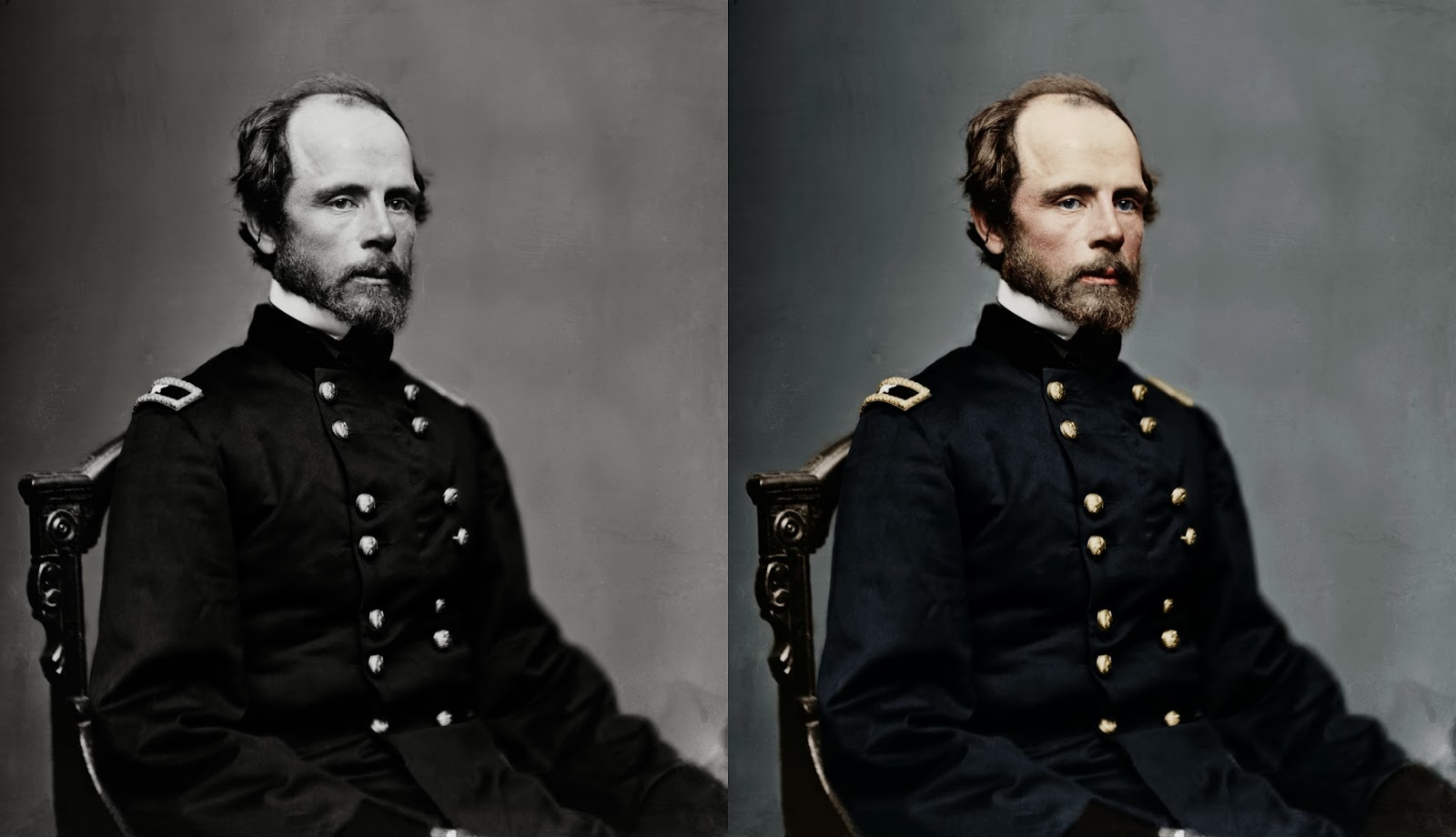
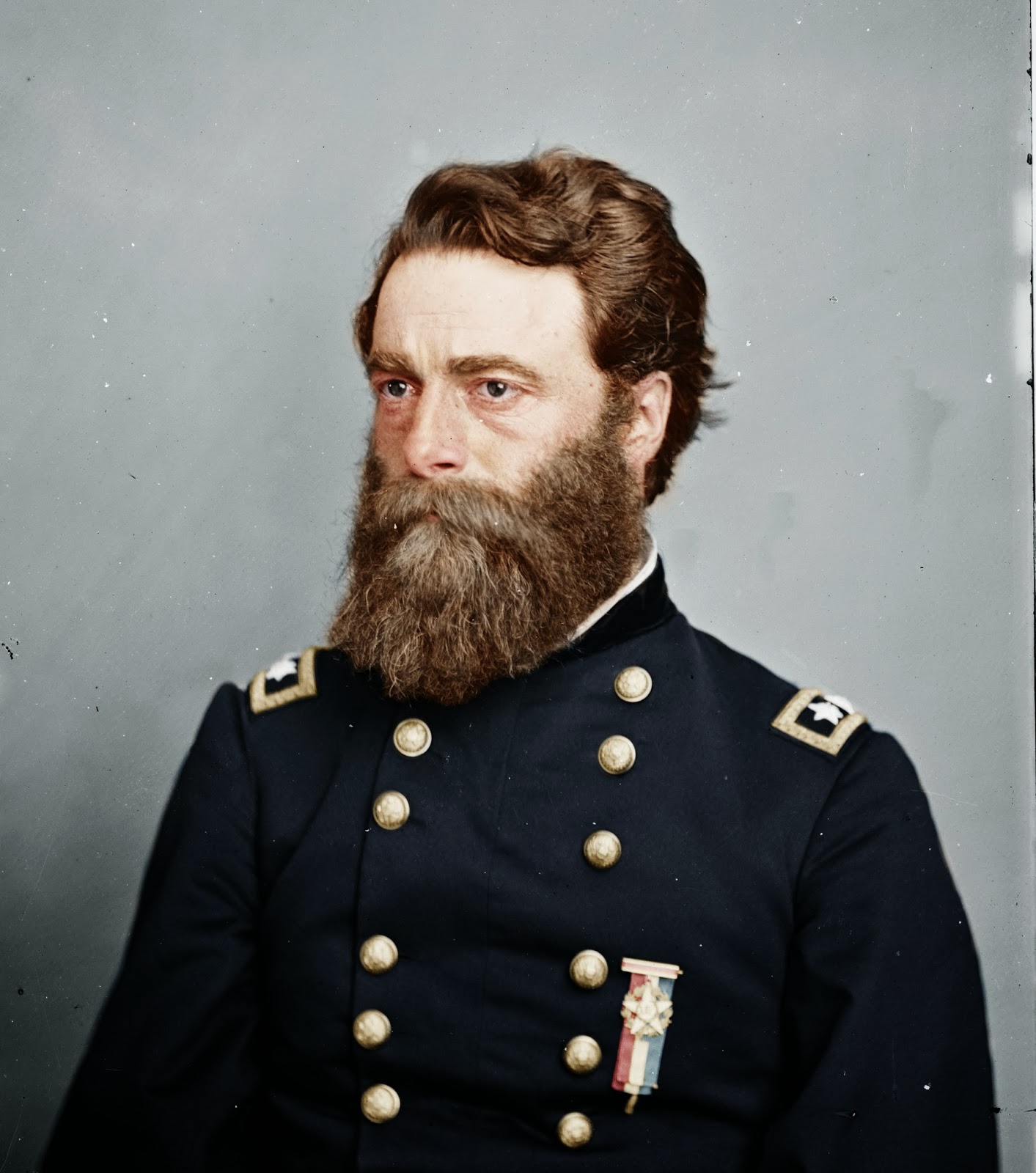
For some time now on Reddit, a group of artists has sought to revivify old photos by imbuing them with color.  They research every aspect of the subject and strive for utmost historical accuracy.  The results are spectacular.

Click to see full size image
For example, consider the side by side comparison of the black and white image of Major General Darius N. Douch with the color image above.  The addition of color brings the subject into our modern visual parlance.  Suddenly, this is no longer an image in a history book, but a living person.


The above image is perhaps an even more shocking demonstration of the extent to which color brings the subject to life.  The individual above, minus the shackles, could appear in any contemporary media ad campaign—think Calvin Klein, Banana Republic, etc.  But in fact this is Lewis Powell, one of the conspirators in the Lincoln assassination.  Powell's assigned part in the plot was to kill Secretary of State William Seward.  He stabbed Seward numerous times in his home and left him permanently disfigured but was subsequently captured and hanged along with Mary Surratt, David Herold, and George Atzerodt.

Here are a few more of what I consider to be the most compelling works of Mads Madsen ("zuzahin" on Reddit) and Jordan Lloyd.  Click on the images to view the detailed, full size versions.  And see the bottom of the article for where you can follow these artists and enjoy their work.  All colorized images below are copyright of Mads Madsen, Jordan Lloyd, or their respective owners.

James A. Garfield, future President of the United States, as a Brigadier General
Colonel Alex Hayes, KIA 1864 during the Wilderness Campaign
John A. Dahlgren
Major General George Armstrong Custer
Major General Joseph Anthony Mower (of "Mower's Charge" at Bentonville fame)
Major General Ambrose Burnside
View from the Capitol at Nashville, Tennessee, 1864 (color version by Sanna Dullaway)
To see more of these artists' incredible work, visit:

Colorized History Reddit Forum — Includes images from WW1, WW2, miscellaneous historical events, popular culture, etc.

American Civil War Colorized Reddit Forum —Mads Madsen's subreddit dedicated to colorized versions of Civil War imagery


Wednesday, October 2, 2013

Williams "Cleaner" Bullets -- The Confusion Persists

It's amazing how much confusion persists to this day about Williams "Cleaner" Bullets.  Here's a recent example from eBay.


This seller claims to have a "Confederate" Cleaner Bullet from Appomattox.  Of course, there's no such thing.  Williams "patent" bullets, Types 1, 2, and 3, were manufactured by Elijah D. Williams exclusively for Federal troops under contract with the US Arsenal.  The Confederacy never had Williams bullets, although today many areas of the South are still covered with Type 3 bullets that were discarded by Union troops.

Here's my article on the blog about the history of these projectiles which continue to be a source of confusion and misinformation.  Caveat emptor!

Monday, September 30, 2013

More History Succumbs to the March of the Bulldozer


You're looking at a unique piece of history which, after surviving for 148 years after the Civil War, is now gone forever.

The photo above shows the original 19th century road bed approaching the city of Morrisville, North Carolina.  A few weeks ago, it was exposed by construction, the surrounding slopes denuded of trees for the first time in over a century, providing an all-too-brief opportunity to see in broad, 21st century daylight, a road almost untouched since the time of the War.

In fact, this was the very road used by General Judson Kilpatrick's cavalry during their attack on Morrisville Station from April 13 -15, 1865.  They followed the road pictured above, traveling from the top of the hill down the slope to the foreground of the image.  From there, they would have had their first sight of Morrisville Station itself just across Crabtree Creek, its rail yards filled with cars loaded full of troop supplies and Confederate wounded.

Kilpatrick's reaction on seeing the cars was to quickly unlimber his guns and proceed to shell the station, with questionable accuracy as it turned out.  Today, the chimney of the Page House in Morrisville, about 60 meters west of the tracks, still bears the scars from some of those shells.

Map showing path of original road, artillery position, and the Page House.

It didn't take long for Johnston to get his troops and supplies moving once the shells started falling and the trains pulled out of Morrisville and steamed away for Greensboro.  Afterwards, the Federals made Morrisville their camp and it was while encamped there that an envoy from Johnston approached with the proposal to discuss terms of surrender which subsequently occurred at the Bennet House near Durham Station.

The Battle of Morrisville Station was the the last large scale engagement of the Civil War —literally the last in which cannon were fired.  Never again were they heard after that day in Morrisville in 1865. 

Look at these pictures —these roads felt the hooves and footsteps of soldiers marching into battle.  They heard the crackle of musketry and trembled with the concussion of cannon fire.  They saw the sun and the stars for over 150 years and, for a few days in 2013, were open once more to the bright Carolina skies.  Now they are gone forever like the men who marched on and slept by them in those long ago days of summer.

Note how deep the 19th century road was.  Direction of march in this image was foreground to background.
Kilpatrick's troops rode from top left to bottom right as they approached the station.
With each passing day more of the 19th century succumbs to modern development.  We can attempt to preserve it with an image here or a relic there or a blog such as this.  But history is ephemeral and of interest to fewer and fewer it seems in today's materialistic society.  

A bullet dropped by Kilpatrick's troops as they moved on Morrisville.

Whether cognizant of history or not, it remains with us today sometimes right under our noses.  That's one aspect of what makes relic hunting so interesting for me. —discovering things, sometimes standing out in plain sight, that others don't see. Most folks living in Morrisville probably never saw the old road over which Kilpatrick's forces rode en route to attacking their town.

General Judson Kilpatrick
In April 1865, Kilpatrick invaded Morrisville.  Today, chances are that Judson Kilpatrick's great, great grandson invades your living room every day!  He is none other than CNN's Anderson Cooper who bears more than a passing resemblance to the notorious General although to my knowledge he's never visited Morrisville.


Sunday, September 1, 2013

August hunt insanity

It's late August.   Temperatures here in central North Carolina are in the low-to-mid 90's (Fahrenheit) with humidity levels routinely between 65-70%.   Those are pretty much perfect conditions if you're an insect or dinosaur but for mammals such as myself it is pretty dang miserable.

After converging on Raleigh back in April 1865 and securing Johnston's surrender, the 90k or so invading Union troops promptly skedaddled back North to cooler climes.  Those guys were smart to get out of the South before Summer kicked in.  I live here so don't really have that option.

Let's face it, sometimes the detecting bug just bites you and not even Jurassic weather conditions can deter you from doing something questionable.  After some pretty intensive research over the past month, combined with the arrival of a new toy, I couldn't resist getting out for a few hunts in spite of the miserable conditions.

New toy: A Minelab CTX 3030

Two of the sites I visited had been exposed by recent construction and were on the verge of disappearing forever underneath asphalt and cheap condos.  I was able to hunt only a limited area on each site and managed only a few bullets from each location but was still happy to save at least a relic or two.

My third hunt was a bit more complex as it was deep in the woods.  And by "deep" I mean the decision to get out there at this time of year was clearly not rational.

In addition to the aforementioned heat which makes dehydration a very real concern, there are two other seriously good reasons to stay the heck out of the woods:   Ticks and poison ivy.  Now those may sound like minor issues but take it from me, you do not want to get a tick-born disease (like I did last year) and you also really do not want to get poison ivy.  I could post a photo of my leg 5 weeks after serious exposure to poison ivy but that would probably not be good for my page view count.  Suffice to say:  It's nasty stuff.

So, resolved to get out there in spite of the weather, ticks, and toxic plants, I dressed appropriately (long sleeves and pants, boots, hat, and gloves),  applied a liberal coating of insect repellent, and entered the dense Carolina forest in search of a Civil War campsite.

For the next couple of hours, as terrain conditions permitted and with the assistance of my Garmin GPS, I performed a rough grid over several acres of heavily wooded land.  Occasionally, I ran across some patches of iron, but the only non-ferrous targets I found were shotgun shells and modern bullets.

Now I'm no spring chicken by any means, but I'm in pretty good shape overall and usually have no problem detecting from morning to nightfall.  But after a few hours of wandering the woods with the mercury showing 92 degrees, I was absolutely wrecked.  My clothes were drenched with perspiration -- it literally looked like someone had turned a garden hose on me.  I couldn't see very well since the lenses of my glasses were coated by spider webs that I'd walk through every 3 or so yards.  Trying to wipe off the spider secretions just made things worse.  So, feeling drained and somewhat defeated, I decided it was high time to make my way back to the car and call it a day.

And suddenly, "DING."  A nice, crisp tone in the headphones.  I looked at the CTX meter and saw a 37 CO value.  That's right in the sweet spot for lead but, given the rest of the day, I was pretty sure I'd found just another modern bullet.  However the depth indicator caused my heart to beat a bit faster -- 8 inches down according to the CTX.  Nice, deep, and old.

Trying not to get my hopes up too much, I dug a deep plug.  And right in the middle of it was this guy.


Yeah baby.  Not only had I found a .58 caliber bullet from the Civil War way back in the middle of the woods, but it had been pulled.  When soldiers on patrol returned to camp, they unloaded their weapon.  And the only way to unload a muzzle-loading rifle (other than by firing) is to use a bullet-puller aka "worm."  Just like a corkscrew, the bullet worm is screwed into the tip of a bullet which allows it to be pulled out of the barrel.

A modern day version of a muzzle-loader worm.

So this was pretty encouraging.  I slowed down and hunted the area around where I found the pulled bullet and, about three feet away, I found a ubiquitous dropped Type III Williams Bullet, another sign that I'd located the camp I was looking for.


In spite of the finds and my restored morale, I was too exhausted to continue detecting.  So I logged the bullets in my GPS and made my way back to the modern miracle of air conditioning in my car.


These are pretty humble finds but nevertheless I'm super excited by the discovery of a new site.  Hopefully there are some more relics left in the camp.  I'll definitely be visiting it again soon but think I'll let it cool down a bit more first.

Finds from the other sites
Happy hunting.

TTP